
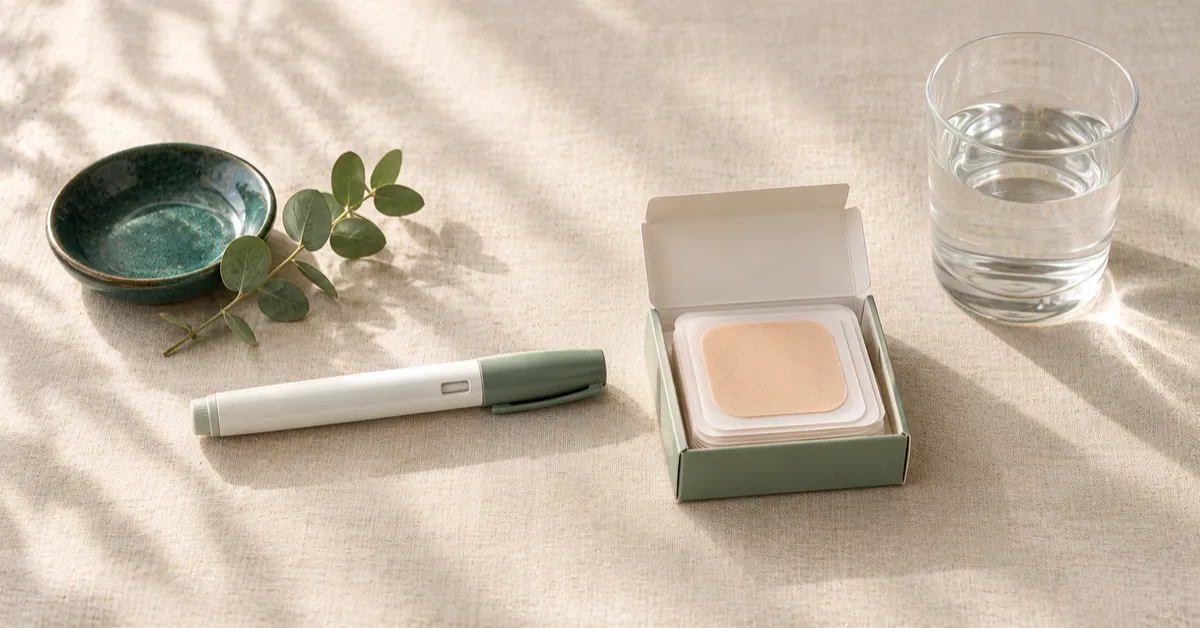
Can You Use HRT and a GLP-1 Medication Together?
Quick answer: Hormone replacement therapy and GLP-1 medications can be used together safely, and for many women in perimenopause and menopause the combination is more effective than either alone. HRT addresses the hormonal drivers of weight gain and protects muscle, bone, and sleep; the GLP-1 addresses appetite and insulin resistance. There is no known harmful interaction. One practical note: GLP-1s slow stomach emptying, which can affect oral medications, so transdermal estrogen (patch or gel) is often preferred.
Why would a woman need both?
Menopause weight gain has two sets of drivers. The hormonal set: estrogen loss shifting fat to the belly, reducing insulin sensitivity, accelerating muscle and bone loss, and wrecking sleep. The metabolic set: insulin resistance, appetite dysregulation, and food noise that has often been building for years. HRT addresses the first. A GLP-1 addresses the second. A woman with both problems, which describes many women over 45, often needs both tools.
Is it safe to combine them?
Yes. There is no pharmacological interaction between estradiol, progesterone, or testosterone and semaglutide or tirzepatide. Thousands of women are on both. The two considerations are:
Absorption of oral hormones. GLP-1s slow gastric emptying, which can change how pills are absorbed. Transdermal estradiol (patch, gel, or spray) bypasses the gut and is the preferred route anyway because of lower clot risk. Oral micronized progesterone is still fine; we simply monitor symptoms.
Nausea early on. Both oral progesterone and GLP-1 dose increases can cause mild nausea. Starting them at different times makes it clear which is responsible.
What are the benefits of combining them?
HRT protects what the GLP-1 threatens. GLP-1 weight loss includes muscle and reduces bone density. Estrogen preserves both. Women on hormone therapy lose less lean mass and less bone during weight loss.
Better sleep means better results. HRT fixes night sweats and the progesterone deficit that fragments sleep. Rested patients have lower cortisol and fewer cravings, and they recover from strength training.
Insulin sensitivity improves from two directions. Estrogen improves it. GLP-1s improve it. Together, fasting insulin and HOMA-IR often normalize faster.
Visceral fat drops faster. Both reduce abdominal fat preferentially.
Mood and energy. HRT stabilizes the mood swings and brain fog of perimenopause, which makes the lifestyle parts of a weight plan easier to sustain.
Skin and hair. Estrogen supports collagen and skin thickness, partly offsetting the "deflated" look that rapid weight loss can cause.
Who is a candidate?
A woman who meets GLP-1 criteria (BMI 30+, or 27+ with a weight-related condition) and who has menopausal symptoms, is within ten years of menopause or under 60, and has no contraindication to hormone therapy (such as a history of breast cancer or certain blood clots). Many women with prediabetes, high triglycerides, or sleep apnea qualify for the GLP-1 and have hot flashes or insomnia that qualify them for HRT. They have simply never been offered both by the same clinician.
Which should start first?
It depends on the dominant problem. If sleep, hot flashes, and mood are severe, HRT first for four to six weeks stabilizes the foundation, then the GLP-1 is added. If insulin resistance and weight are the pressing issue and menopause symptoms are mild, the GLP-1 can start first with HRT layered in. Often we start both within the same month, staggered by a few weeks so side effects can be sorted out.
What labs and monitoring are needed?
Baseline: fasting insulin, glucose, A1c, lipids, full thyroid panel, estradiol, FSH, progesterone, total and free testosterone, vitamin D, ferritin, B12, hs-CRP, and liver enzymes. Body composition at baseline and every two to three months. Bone density if there are risk factors. Hormone levels and metabolic markers rechecked at three months and adjusted.
What are the risks?
The risks are those of each treatment individually: for the GLP-1, nausea, constipation, gallbladder issues, pancreatitis, and muscle loss; for HRT, small increases in breast cancer and clot risk that are lowest with transdermal estrogen and micronized progesterone started within ten years of menopause. The combination does not add new risks and, by protecting muscle and bone, arguably reduces one of the GLP-1's most important ones.
How long before results?
Sleep and hot flashes often improve within two to four weeks of starting HRT. Appetite changes from the GLP-1 appear within two weeks. Weight and waist changes build over months two through nine. Lab markers improve over three to six months. Most women say the biggest change is feeling like themselves again, which comes first.
What affects the cost in San Jose?
Cost depends on the form of hormone therapy (generic estradiol and micronized progesterone are often among the more affordable options), your GLP-1 medication and dose, and how detailed your lab panel is. Ask for a clear, written price for your full plan before you start, including follow-up visits and labs.
When should I see a physician?
If you are a woman over 40 with weight gain around your middle, hot flashes or poor sleep, and fatigue or cravings, you likely have both sets of drivers. Look for a physician who treats hormones and metabolic health together. Being sent to a gynecologist for hormones and a separate weight clinic for a GLP-1 means nobody is looking at the whole picture.
Frequently asked questions
Is there any drug interaction between estrogen and semaglutide or tirzepatide?
No direct pharmacological interaction. The one practical consideration is that GLP-1s slow stomach emptying, which can alter the absorption of oral pills. Transdermal estrogen avoids the issue and is preferred anyway for its lower clot risk.
Should I start HRT or the GLP-1 first?
If sleep, hot flashes, or mood are severe, hormone therapy first for four to six weeks stabilizes the foundation. If insulin resistance and weight are the pressing problem and menopause symptoms are mild, the GLP-1 can lead. Often both start within the same month, staggered by a few weeks.
Does HRT make GLP-1 weight loss faster?
It improves the quality of the loss more than the speed. Women on hormone therapy lose less muscle and bone, keep more weight off the abdomen, and sleep better, which lowers cortisol and cravings. Many also find the GLP-1 better tolerated once they are sleeping.
Can I use progesterone and a GLP-1 together?
Yes. Oral micronized progesterone is taken at bedtime; its absorption may be slightly altered by the GLP-1, so we monitor symptoms and adjust if needed. Starting them at different times makes it clear which is responsible for any early nausea.
Will my gynecologist and weight clinic coordinate this?
In practice, rarely, which is why it helps to have one physician who manages both. If you do have two providers, make sure each knows the full medication list and the labs the other has ordered.
Dr. Hirmendi's Perspective
This combination is the heart of why I built my practice the way I did. The woman who comes to me gaining weight at 48 doesn't have a weight problem and a hormone problem. She has one body going through one transition, and treating it in two separate offices never made sense to me. In my practice, I evaluate hormones and metabolism in the same visit, I usually use transdermal bioidentical estrogen with a GLP-1 when both are indicated, and I track body composition and bone health so that she comes out of the process stronger, not just smaller.
Ready for a plan that treats the whole picture? Book a Discovery Call with our physician in San Jose. Call or text 408-649-1626 or book online at rejuvememedspa.com.
Written and medically reviewed by Mahwash Hirmendi, MD, MPH
Board-Certified Emergency Medicine · Board-Certified Wound Management · Functional Medicine Practitioner · 25+ years of clinical experience
Medical Director, RejuveMe Wellness Clinic, San Jose, California

